
One of the deadliest viral diseases in the world is Ebola virus disease. There are different types of Ebola virus with the Zaire Ebola Virus in DR Congo being very virulent resulting with a high disease induced rate. The resurgence of this disease makes it a necessity for a more robust modelling approach to understand its dynamics for proper policy implementation. In this work, a novel nonlinear mathematical model is developed using compartmental approach which is common in epidemiological modelling. The developed model strategically incorporated quarantine through contact tracing and mandatory vaccination of all quarantined individuals who are tested to be negative after the incubation period. In addition to this intervention strategy, a number of susceptible and recovered individuals with a waned immunity are also vaccinated. The developed model was assessed to be biologically feasible. The next generation matrix was used to determine the basic reproduction number while the Jacobian approach was used to linearise the system leading it into its stability analysis. Additionally, the 4th Order Runge Kutta iterative scheme was extended on the model for simulations purposes. The results show that the model has two fixed points. These are the disease-free equilibrium point where the disease will fail to exist within the population, and the endemic point at which the disease will continue to persist within the population. The model was examined to be stable with all eigenvalues being negative. The numerical results showed that the appearance of the disease in the population will cause a rise in the number of exposed, quarantined, and infected compartments. This will lead to a decline in the number of susceptible persons. The basic reproduction number was attained to be 0.09779 indicating that the Zaire Ebola Virus disease will fail to exist over time. It is therefore realised that the developed model with the incorporated interventions is an effective approach to control Zaire Ebola Virus if the strategies are efficiently implemented.
| Published in | American Journal of Health Research (Volume 13, Issue 5) |
| DOI | 10.11648/j.ajhr.20251305.14 |
| Page(s) | 281-293 |
| Creative Commons |
This is an Open Access article, distributed under the terms of the Creative Commons Attribution 4.0 International License (http://creativecommons.org/licenses/by/4.0/), which permits unrestricted use, distribution and reproduction in any medium or format, provided the original work is properly cited. |
| Copyright |
Copyright © The Author(s), 2025. Published by Science Publishing Group |
Vaccination, Quarantine, Runge Kutta, Basic Reproduction Number, Disease-Free Equilibrium
 (1)
(1) Parameters | Description |
|---|---|
| Fraction of the susceptible individuals who are exposed |
| Natural birth rate |
| Progression rate of exposed individuals who are identified, contact traced and quarantined |
| Proportion of quarantined individuals who are tested to be infected |
| Recovery rate of infected individuals |
| Rate of recovered individuals who lose immunity into the susceptible compartment |
| Rate at which exposed non-contact traced persons revert into susceptible compartment |
| Natural death rate. |
| Rate at which non-contact traced exposed individuals move into infected compartment. |
| Both disease induced and natural death rate |
| Rate at which susceptible individuals receive vaccination. |
| Rate at which vaccinated individuals lose immunity to become susceptible. |
| Fraction of recovered whose immunity wanes over time get vaccinated |
| Proportion of the quarantined individuals who are tested to be negative and vaccinated. |
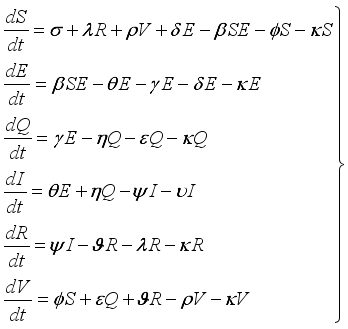 (2)
(2)  .
.  as:
as:  (3)
(3)  and its endemic equilibrium
  . At the
  , we set
  and solve for
  and
and  . This yields:
  (4)
(4)  , the Zaire Ebola Virus disease persist in the population over time. The endemic equilibriums deduced from Equation (2) yields:
 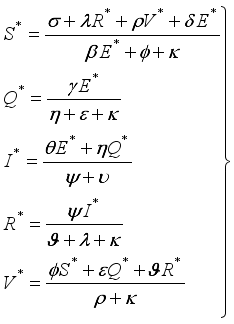 (5)
(5)  is the average number of secondary infections caused by a single infected individual in a fully susceptible population. In this Zaire Ebola Virus disease model in Equation (2),
  is derived from the exposed and infected compartments as:
 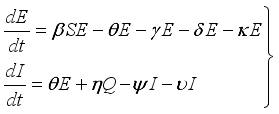 (6)
(6)  of the model. Here, we let
  . The NGM is such that Equation (6) is decomposed into two matrices. This gives
 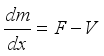 (7)
(7)  is the transmission matrix and
  is the transition matrix.
 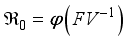 (8)
(8) 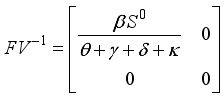 (9)
(9) 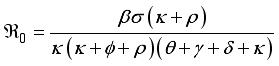 (10)
(10)  , the Zaire Ebola Virus disease will die out, else the disease will continue to persist since the number of infectious cases will continue to rise. This will cause the system to be unstable.
  at the
  . We further compute the eigenvalues of
  to enable us use the sign of the eigenvalues to evaluate the stability of the disease.
  of this model is less than one, else unstable.
  is given by:
 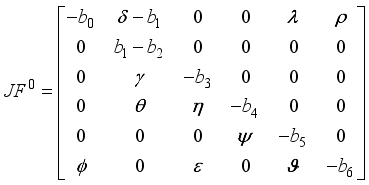 (11)
(11) 
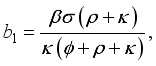

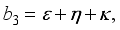

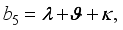 and
and 
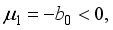
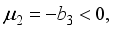
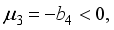
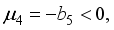
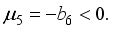 It is seen than
  Also, the sixth eigenvalue is
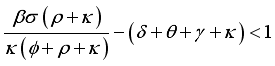
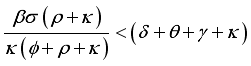
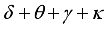 yields
 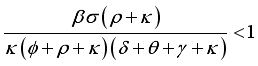 (12)
(12)  all the eigenvalues of
  are negatives. Therefore,
  is LAS. At this LAS point, there will be no EBOV disease threat in the population. Additionally, if
  thus
thus 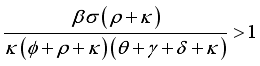
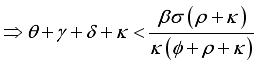
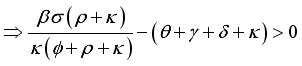
 . Hence,
  becomes unstable anytime
 and
and 






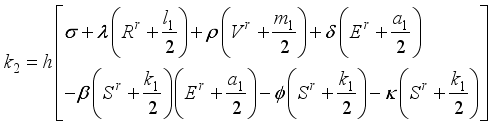
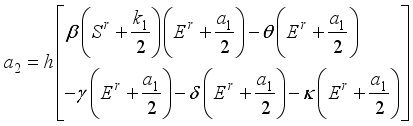
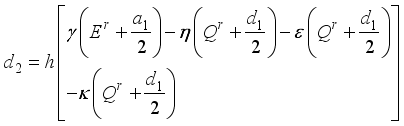
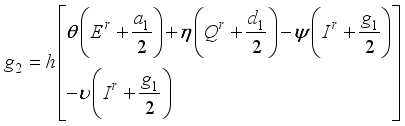
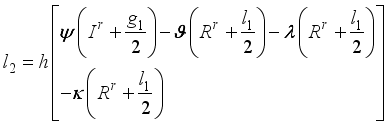
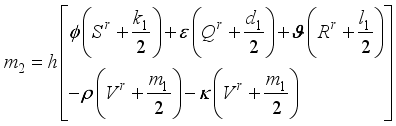
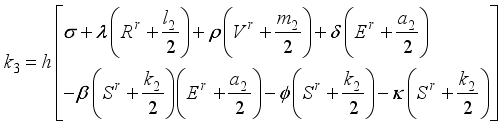
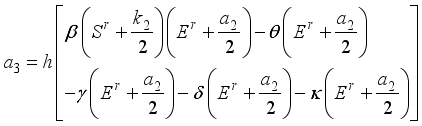
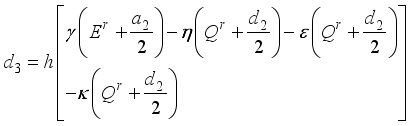
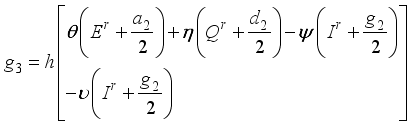
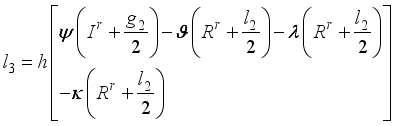
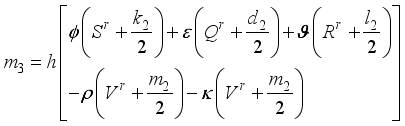

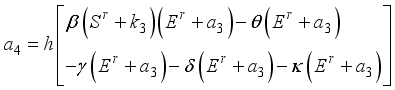
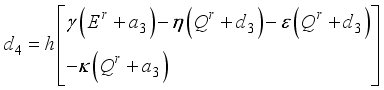
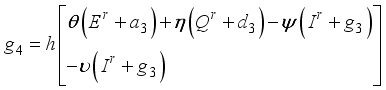
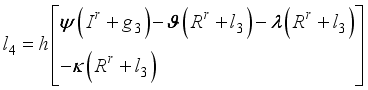
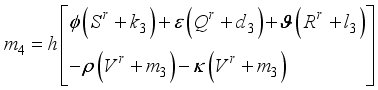
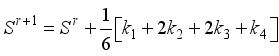 (13)
(13)  (14)
(14)  (15)
(15)  (16)
(16) 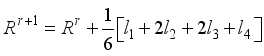 (17)
(17)  (18)
(18) Compartment | Value/millions | Source |
|---|---|---|
18.8 | [ 28, 4] | |
0.25 | [ 28, 4] | |
0.0001 | [ 28, 29] | |
0.003481 | [ 28, 29] | |
0.001162 | [ 28, 29] | |
0.303 | [ 28, 29] | |
Parameter | ||
0.28770 | [ 17, 24, 4] | |
0.02020 | Assumed | |
0.09410 | Assumed | |
0.09000 | Assumed | |
0.33380 | Computed | |
0.02000 | Assumed | |
0.09500 | Assumed | |
0.00500 | Assumed | |
0.76130 | [ 17, 24, 4] | |
0.53000 | [ 30, 31] | |
0.08000 | Assumed | |
0.00200 | Assumed | |
0.07000 | Assumed | |
0.02000 | Assumed | |
 . Also, the vaccination strategy was applied in three compartments as seen in Figure 1. We considered a variation in
  respectively as all other values remain unchanged over time.
  .
. increases, the number of quarantiened individuals increase in Figure 3(c). The impact of this is that, the number of susceptibility declines in Figure 3(a). Also, the immediate peak of the exposed compartments in Figure 3(b) declines, while the infected compartment in Figure 3(d) which experienced an earlier rise in the number of cases also declined to zero in less than two months. Additionally, the recovered persons shot up in the early stages of the disease, but declined as the numbers in the infected conpartment declined. Finally, the number of people vaccinated peaked but gradually decreased over time. It is seen from Figure 3 that a variation in
  actually causes a change in each state or compartments. Implicitely, a proper implementation of the quarantine intervention through contact tracing has a positive effect in controlling the spread of the Ebola disease in DR congo.
  .
. causes a rapid decline in the number of susceptible persons, and a sharp peak in the exposed persons. However, the number of exposed persons reduces to near zero within the first month and finally extinguishes in less than two months (60 days). Figure 4(c) to Figure 4(e) show that an increase in
  causes a change in decline in the number of persons who are quarantined, infected and recovered. This means that a change in
  has its proportional change in the quarantined, infected and the recovered compartments. Additionally, Figure 4(f) shows that an increase in
  increases the number of persons who are vaccinated over time. Generally, the intervention strategy to increase the rate of
  has a positive ripple effect in extinguishing the disease within the shortest possible time whiles increasing the number of vaccinated persons, and further reducing the number of individuals in the susceptible chamber.
  during the outbreak of Zaire Ebola disease in DR Congo.
  .
. causes a sharp decline in the susceptible compartment to near zero in less than a month, but finally goes to zero as
  increases. Again, Figure 5(b) to Figure 5(e) show that, a variation in
  causes a sharp rise in the number of individuals who are exposed, quarantined, infected and recovered in the first 50 days, but decline to zero by the 100th day. Additionally, an increase in
  causes a proportional change in the number of exposed, quarantined, infected and recovered persons. Also, a variation in
  causes a proportional variation in the number of vaccinated persons. It is further seen in Figure 5(f) that an increase in
  increase the number of vaccinated individuals. Finally, the strategy to increase
  has a positive impact by leaving no person to be susceptible within the population as a result of the vaccination of the total populace as seen in Figure 5(a) and Figure 5(f).
  .
. causes an immediate reduction in the number of susceptible persons. Again, 6(a) to 6(f) show that a change in
  causes a proportional change in the exposed, quarantined, infected, recovered and the vaccinated compartments. Additionally, a decrease in the value of
  causes a variation in the number of individuals in the exposed, quarantined, infected, recovered and vaccinated chambers. As
  increases, Figure 6(b) to Figure 6(e) rise and fall to zero in less than 100 days. It is finally seen in Figure 6(f) that an increase in
  increases the number of persons vaccinated over time.
 DR | Democratic Republic |
EVD | Ebola Virus Disease |
NGM | Next Generation Matrix |
RK4 | Runge-Kutta Order 4 |
rVsV - ZEBOV | recombinant Vesicular stomatitis Virus-Zaire Ebola Virus |
| [1] | Bibby, K., Casson, L. W., Stachler, E., Haas, C. N. Ebola virus persistence in the environment: state of the knowledge and research needs. Environmental Science & Technology Letters. 2015, 2(1), 2-6. |
| [2] |
World Health Organization. Ebola disease: Key facts. Available from:
https://www.who.int/news-room/fact-sheets/detail/ebola-virus-disease (accessed 4 September 2025). |
| [3] |
Centres Disease Control. CDC: Signs and symptoms. Available from:
https://www.cdc.gov/ebola/signs-symptoms/?CDC_AAref_Val=https://www.cdc.gov/vhf/ebola/symptoms/index.html (accessed 7 September 2025). |
| [4] | Tahir, M., Inayat Ali Shah, S., Zaman, G., and Muhammad, S. Ebola virus epidemic disease its modeling and stability analysis required abstain strategies, Cogent Biology. 2018, 4(1), 1488511. |
| [5] | Ivorra, B., Ngom, D., Ramos, Á. M. Be-codis: A mathematical model to predict the risk of human diseases spread between countries-validation and application to the 2014–2015 ebola virus disease epidemic. Bulletin of Mathematical Biology. 2015, 77(9), 1668-1704. |
| [6] | Legrand, J., Grais, R. F., Boelle, P. Y., Valleron, A. J., Flahault, A. Understanding the dynamics of Ebola epidemics. Epidemiology & Infection. 2007, 135(4), 610-621. |
| [7] | Leroy, E. M., Kumulungui, B., Pourrut, X., Rouquet, P., Hassanin, A., Yaba, P., Délicat, A., Paweska, J. T., Gonzalez, J. P., Swanepoel, R. Fruit bats as reservoirs of Ebola virus. Nature. 2005, 438(7068), 575-576. |
| [8] |
Centers for Disease Control and Prevention. CDC: Outbreak History: Available from:
https://www.cdc.gov/ebola/outbreaks/ (accessed 11 September 2025). |
| [9] | Henao-Restrepo, A. M., Camacho, A., Longini, I. M., Watson, C. H., Edmunds, W. J., Egger, M., Carroll, M. W., Dean, N. E., Diatta, I., Doumbia, M., Draguez, B. Efficacy and effectiveness of an rVSV-vectored vaccine in preventing Ebola virus disease: final results from the Guinea ring vaccination, open-label, cluster-randomised trial (Ebola Ça Suffit!). The Lancet. 2017, 389(10068), 505-518. |
| [10] | Dembek, Z., Hadeed, S., Tigabu, B., Schwartz-Watjen, K., Glass, M., Dressner, M., Frankel, D., Blaney, D., Eccles III, T. G., Chekol, T., Owens, A. Ebola virus disease outbreaks: lessons learned from past and facing future challenges. Military Medicine. 2024, 189(7-8), e1470-e1478. |
| [11] | Daniel, D. F. N. R. Epidemiological and Clinical Characteristics, Diagnosis and Prevention of Ebola Virus Disease. Master's thesis. Lithuanian University of Health Sciences. University of Alberta. 2025, 1-65. |
| [12] | Forgie, E. M. E. “The West Knows Best”: Unintended Consequences of Western Aid During the West African and Democratic Republic of the Congo Ebola Epidemics. |
| [13] | Banadyga, L., Zhu, W., Kailasan, S., Howell, K. A., Franaszek, K., He, S., Siragam, V., Cheng, K., Yan, F., Moffat, E., Cao, W. Atypical Ebola virus disease in a nonhuman primate following monoclonal antibody treatment Is associated with glycoprotein mutations within the fusion loop. MBio. 2021, 12(1), 10-1128. |
| [14] |
World Health Organization. WHO: Ebola Virus Disease Democratic Republic of the Congo: External Situation Report 45 / 2019. Available from:
https://tdr.who.int/home/our-work/global-engagement/ebola-virus-disease-democratic-republic-of-congo-external-situation-report-45-2018 (accessed 2 September 2025). |
| [15] |
World Health Organization. WHO: Ebola virus disease-Democratic Republic of the Congo Disease outbreak news.
https://www.who.int/emergencies/disease-outbreak-news/item/2025-DON580 (accessed 7 September 2025). |
| [16] | Ahmad, W., Abbas, M. Effect of quarantine on transmission dynamics of Ebola virus epidemic: a mathematical analysis. The European Physical Journal Plus. 2021, 136(4), pp. 1-33. |
| [17] | Ahmad, W., Rafiq, M., Abbas, M. Mathematical analysis to control the spread of Ebola virus epidemic through voluntary vaccination. The European Physical Journal Plus. 2020, 135(10), p. 775. |
| [18] | Brettin, A., Rossi-Goldthorpe, R., Weishaar, K., Erovenko, I. V. Ebola could be eradicated through voluntary vaccination. Royal Society Open Science. 2021, 5(1), p. 171591. |
| [19] | Chowell, G., Tariq, A., Kiskowski, M. Vaccination strategies to control Ebola epidemics in the context of variable household inaccessibility levels. PLOS Neglected Tropical Diseases. 2019, 13(11), p. e0007814. |
| [20] | Potluri, R., Kumar, A., Maheshwari, V., Smith, C., Oriol Mathieu, V., Luhn, K., Callendret, B., Bhandari, H. Impact of prophylactic vaccination strategies on Ebola virus transmission: a modeling analysis. Plos one. 2020, 15(4), p. e0230406. |
| [21] | Area, I., Ndairou, F., Nieto, J. J., Silva, C. J., Torres, D. F. Ebola model and optimal control with vaccination constraints. arXiv preprint arXiv: 1703.01368. 2017. |
| [22] | Madubueze, C. E., Kimbir, A. R., Onah, E. S., Aboiyar, T. Analysis of a Mathematical Model of Ebola Virus Disease with Contact Tracing and Quarantine Measures. Transaction of the Nigerian Association of Mathematical Physics. 2017, 3, 75-82. |
| [23] | Mhlanga, A. Dynamical analysis and control strategies in modelling Ebola virus disease. Advances in Difference Equations. 2019, 2019(1), p. 458. |
| [24] | Rafiq, M., Ahmad, W., Abbas, M., Baleanu, D. A reliable and competitive mathematical analysis of Ebola epidemic model. Advances in Difference Equations. 2020, 2020(1), p. 540. |
| [25] | Villanueva, R. J., Arenas, A. J., González-Parra, G. A nonstandard dynamically consistent numerical scheme applied to obesity dynamics. Journal of Applied Mathematics. 2008, 2008(1), p. 640154. |
| [26] | Tahir, M., Anwar, N., Shah, S. I. A., Khan, T. Modeling and stability analysis of epidemic expansion disease Ebola virus with implications prevention in population. Cogent Biology. 2019, 5(1), p. 1619219. |
| [27] | Ali, M. A., Rafiq, M., Ozair Ahmad, M. Numerical analysis of a modified SIR epidemic model with the effect of time delay. Punjab University Journal of Mathematics. 2020, 51(1). |
| [28] |
City population Menu: CONGO (DEM. REP.): Provinces. Available from:
https://www.citypopulation.de/en/drcongo/cities/ (Accessed 11 September 2025). |
| [29] | International Federation of Red Cross. IFRC: Emergency Plan of Action Final Report: Democratic Republic of Congo (DRC), AFRICA, Ebola Virus Disease Epidemic, 2024, pp. 1-61. |
| [30] | Rachah, A., Torres, D. F. Predicting and controlling the Ebola infection. Mathematical methods in the Applied Sciences. 2017, 40(17), 6155-6164. |
| [31] | Agbata, C. A. Mathematical Model for the Control of Ebola Virus Disease with Vaccination Effect. Journal of Mathematical Epidemiology. 2025, 1(1), 26-48. |
APA Style
Nti, A. E., Ampofi, I., Baidoo, J. (2025). Modelling the Spread of Zaire Ebola Virus Disease with Quarantine and Vaccination Interventions. American Journal of Health Research, 13(5), 281-293. https://doi.org/10.11648/j.ajhr.20251305.14
ACS Style
Nti, A. E.; Ampofi, I.; Baidoo, J. Modelling the Spread of Zaire Ebola Virus Disease with Quarantine and Vaccination Interventions. Am. J. Health Res. 2025, 13(5), 281-293. doi: 10.11648/j.ajhr.20251305.14
AMA Style
Nti AE, Ampofi I, Baidoo J. Modelling the Spread of Zaire Ebola Virus Disease with Quarantine and Vaccination Interventions. Am J Health Res. 2025;13(5):281-293. doi: 10.11648/j.ajhr.20251305.14
@article{10.11648/j.ajhr.20251305.14,
  author = {Alex Emmanuel Nti and Isaac Ampofi and Jehovah Baidoo},
  title = {Modelling the Spread of Zaire Ebola Virus Disease with Quarantine and Vaccination Interventions
},
  journal = {American Journal of Health Research},
  volume = {13},
  number = {5},
  pages = {281-293},
  doi = {10.11648/j.ajhr.20251305.14},
  url = {https://doi.org/10.11648/j.ajhr.20251305.14},
  eprint = {https://article.sciencepublishinggroup.com/pdf/10.11648.j.ajhr.20251305.14},
  abstract = {One of the deadliest viral diseases in the world is Ebola virus disease. There are different types of Ebola virus with the Zaire Ebola Virus in DR Congo being very virulent resulting with a high disease induced rate. The resurgence of this disease makes it a necessity for a more robust modelling approach to understand its dynamics for proper policy implementation. In this work, a novel nonlinear mathematical model is developed using compartmental approach which is common in epidemiological modelling. The developed model strategically incorporated quarantine through contact tracing and mandatory vaccination of all quarantined individuals who are tested to be negative after the incubation period. In addition to this intervention strategy, a number of susceptible and recovered individuals with a waned immunity are also vaccinated. The developed model was assessed to be biologically feasible. The next generation matrix was used to determine the basic reproduction number while the Jacobian approach was used to linearise the system leading it into its stability analysis. Additionally, the 4th Order Runge Kutta iterative scheme was extended on the model for simulations purposes. The results show that the model has two fixed points. These are the disease-free equilibrium point where the disease will fail to exist within the population, and the endemic point at which the disease will continue to persist within the population. The model was examined to be stable with all eigenvalues being negative. The numerical results showed that the appearance of the disease in the population will cause a rise in the number of exposed, quarantined, and infected compartments. This will lead to a decline in the number of susceptible persons. The basic reproduction number was attained to be 0.09779 indicating that the Zaire Ebola Virus disease will fail to exist over time. It is therefore realised that the developed model with the incorporated interventions is an effective approach to control Zaire Ebola Virus if the strategies are efficiently implemented.
},
 year = {2025}
}
TY  - JOUR
T1  - Modelling the Spread of Zaire Ebola Virus Disease with Quarantine and Vaccination Interventions

AU  - Alex Emmanuel Nti
AU  - Isaac Ampofi
AU  - Jehovah Baidoo
Y1  - 2025/10/30
PY  - 2025
N1  - https://doi.org/10.11648/j.ajhr.20251305.14
DO  - 10.11648/j.ajhr.20251305.14
T2  - American Journal of Health Research
JF  - American Journal of Health Research
JO  - American Journal of Health Research
SP  - 281
EP  - 293
PB  - Science Publishing Group
SN  - 2330-8796
UR  - https://doi.org/10.11648/j.ajhr.20251305.14
AB  - One of the deadliest viral diseases in the world is Ebola virus disease. There are different types of Ebola virus with the Zaire Ebola Virus in DR Congo being very virulent resulting with a high disease induced rate. The resurgence of this disease makes it a necessity for a more robust modelling approach to understand its dynamics for proper policy implementation. In this work, a novel nonlinear mathematical model is developed using compartmental approach which is common in epidemiological modelling. The developed model strategically incorporated quarantine through contact tracing and mandatory vaccination of all quarantined individuals who are tested to be negative after the incubation period. In addition to this intervention strategy, a number of susceptible and recovered individuals with a waned immunity are also vaccinated. The developed model was assessed to be biologically feasible. The next generation matrix was used to determine the basic reproduction number while the Jacobian approach was used to linearise the system leading it into its stability analysis. Additionally, the 4th Order Runge Kutta iterative scheme was extended on the model for simulations purposes. The results show that the model has two fixed points. These are the disease-free equilibrium point where the disease will fail to exist within the population, and the endemic point at which the disease will continue to persist within the population. The model was examined to be stable with all eigenvalues being negative. The numerical results showed that the appearance of the disease in the population will cause a rise in the number of exposed, quarantined, and infected compartments. This will lead to a decline in the number of susceptible persons. The basic reproduction number was attained to be 0.09779 indicating that the Zaire Ebola Virus disease will fail to exist over time. It is therefore realised that the developed model with the incorporated interventions is an effective approach to control Zaire Ebola Virus if the strategies are efficiently implemented.

VL  - 13
IS  - 5
ER  -
Department of Mathematical Sciences, University of Mines and Technology (UMaT), Tarkwa, Ghana
Department of Mathematical Sciences, University of Mines and Technology (UMaT), Tarkwa, Ghana
Department of Mathematical Sciences, University of Mines and Technology (UMaT), Tarkwa, Ghana
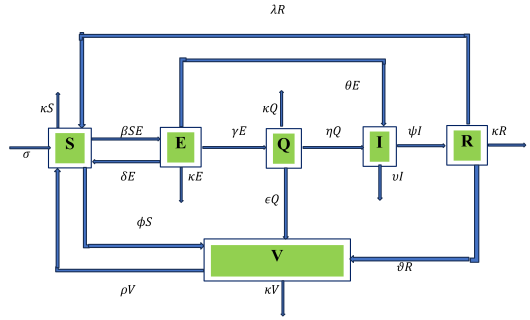
Figure 1. Compartmental Scheme of Zaire Ebola Virus Disease.
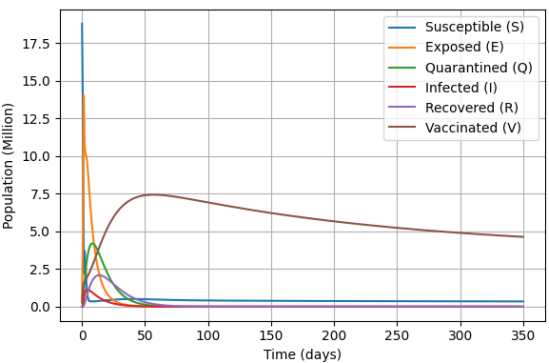
Figure 2. Dynamics of All Compartments.
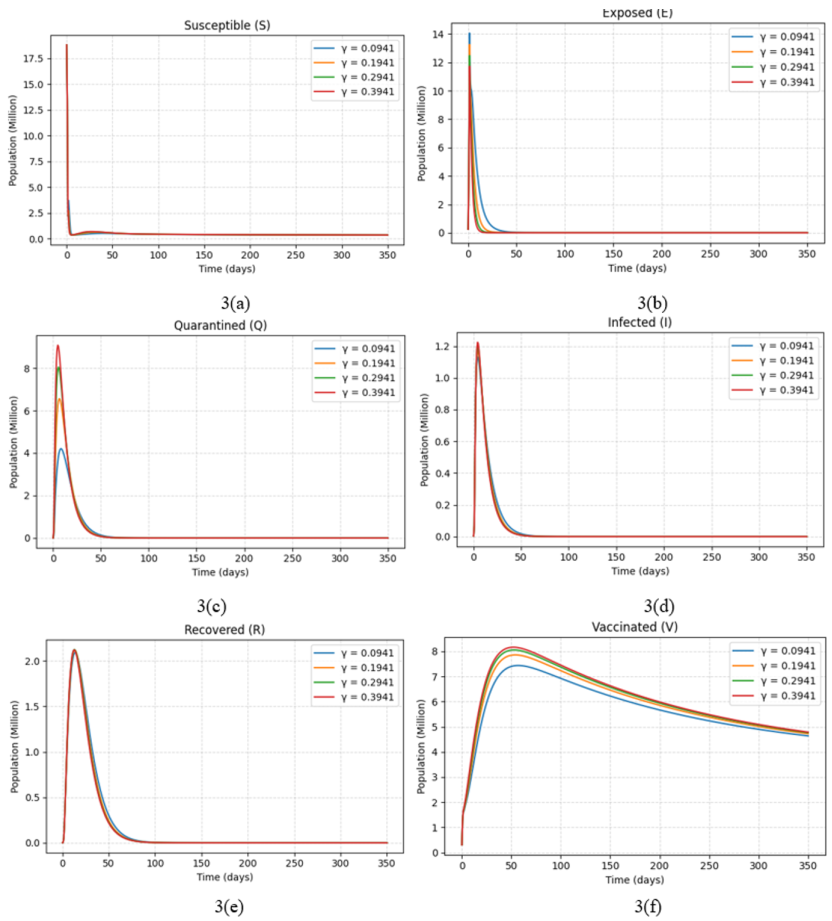
Figure 3. Zaire Ebola Virus disease dynamics with variation in .
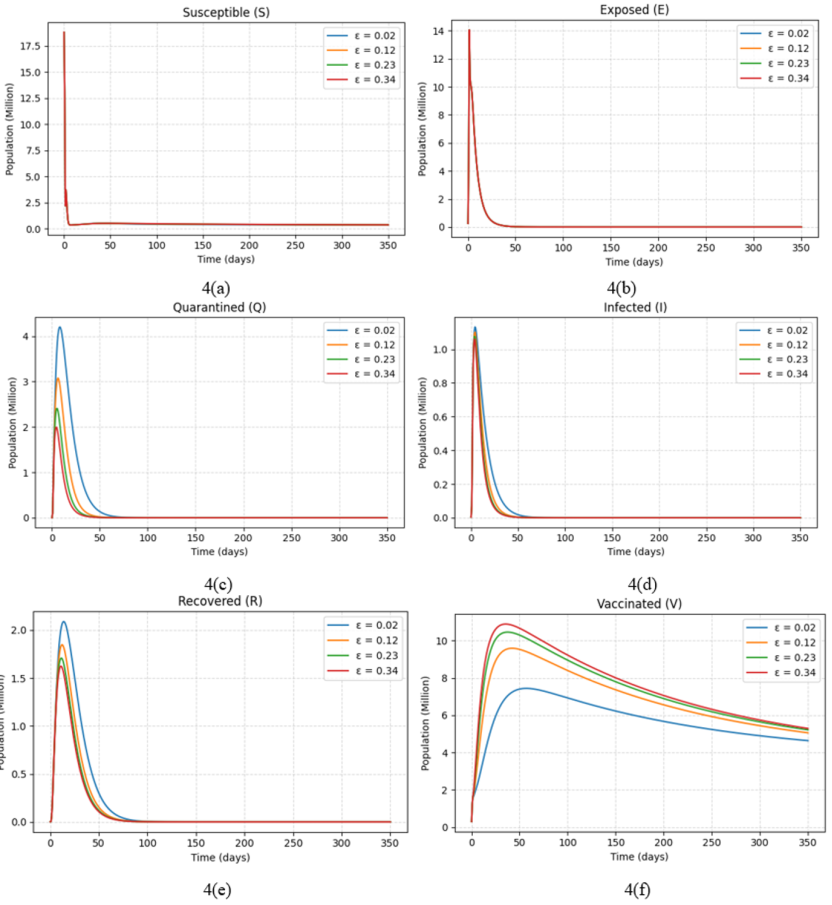
Figure 4. Zaire Ebola Virus disease dynamics with variation in .
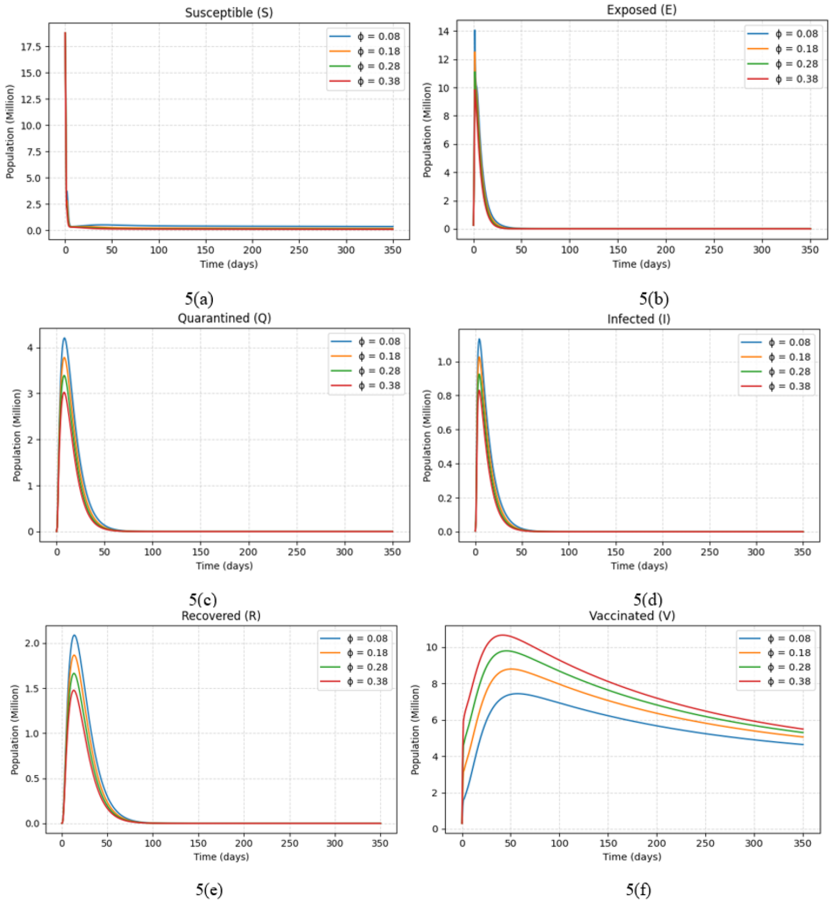
Figure 5. Zaire Ebola Virus disease dynamics with variation in .
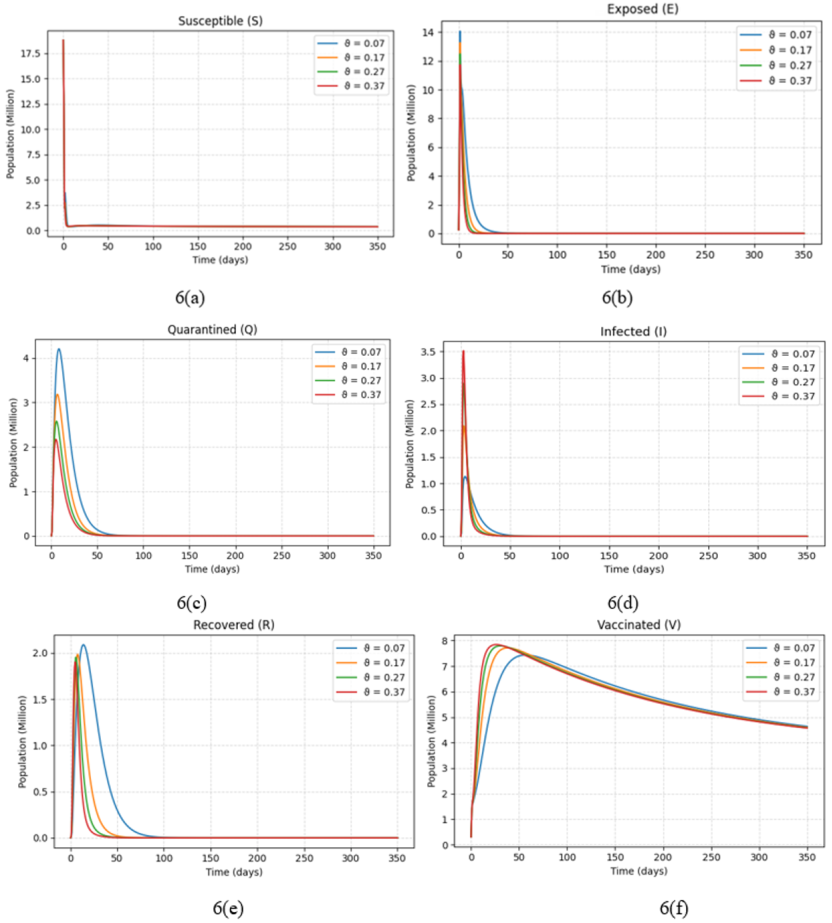
Figure 6. Zaire Ebola Virus disease dynamics with variation in .

Information



 Share This Article
 Twitter
 Linked In
 Facebook
 is given by the spectral radius
  of the next generation matrix. This yields Equation (
 yields:
  then
then  , else
  .
.  . This indicates that
  if and only if
  .
.  in the developed model.
  Copy
Copy Download